When you look at a geometry problem and ask the diagram shows klm which term describes point n, you’re diving into one of the most useful ideas in triangles. This question pops up in many homework sets and tests. It helps you spot special points where lines meet inside a shape. In this guide, we’ll walk through it all in easy steps. You’ll see why point N fits one key term perfectly. We’ll use clear examples, lists, and even some fun facts to make it stick. By the end, you’ll feel confident tackling similar problems.
What Makes This Question So Common in Geometry?
Geometry lessons often use diagrams to show how points and lines work together. The diagram shows klm which term describes point n is a classic example. It tests your knowledge of triangle parts. Students from middle school to high school see this a lot. Why? Because triangles are everywhere – in roofs, bridges, and even art. Knowing the answer helps you understand balance and shapes better.
In the diagram, triangle KLM has lines from each corner to the middle of the opposite side. These lines cross at point N. That crossing spot isn’t random. It’s a special point with cool jobs. Let’s break it down.
The Diagram Shows KLM Which Term Describes Point N: It’s the Centroid!
The diagram shows klm which term describes point n – and the term is centroid. Point N sits right where the three medians meet. A median is a line from a vertex (like K) to the midpoint of the side across from it (like side LM).
Here’s why this matters:
- The centroid is always inside the triangle.
- It splits each median into a 2:1 ratio. The longer part is closer to the corner.
- It acts like the “balance point” of the triangle.
Imagine a paper triangle. If you balance it on a pin at the centroid, it won’t tip over. That’s a real-world trick!
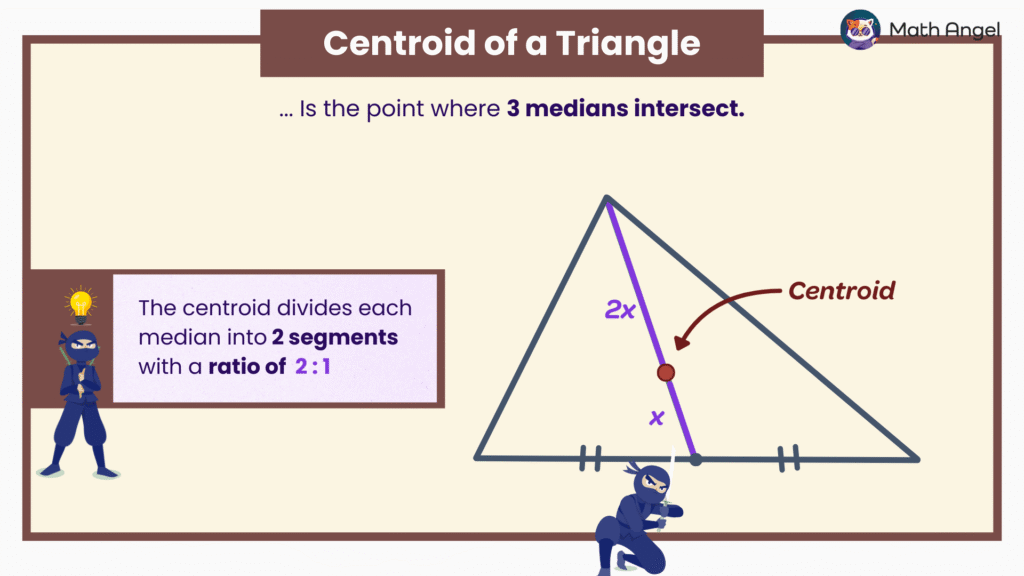
This image shows a triangle with medians meeting at the centroid. See how the lines divide each median?
A Simple Look at Medians and Why They Matter
Medians are key to the diagram shows klm which term describes point n. Each median connects a corner to the middle of the far side. In triangle KLM:
- From K to the midpoint of LM.
- From L to the midpoint of KM.
- From M to the midpoint of KL.
These three lines always cross at one spot: the centroid. No matter the triangle’s shape, they meet!
Why do they meet? It’s a basic rule in geometry. You can prove it with simple math or drawings. We’ll show you how later.
Quick Tip: To find the midpoint of a side, just halve the length. For example, if side LM is 10 units, its midpoint is 5 units from L and M.
Properties of the Centroid – Easy to Remember
The centroid has many handy traits. Here are the top ones in a clear list:
- Inside Location: It’s always inside the triangle, even in skinny or wide ones.
- 2:1 Split: On each median, the centroid is two-thirds from the corner to the side.
- Average of Corners: If you know the corners’ positions, the centroid is their “middle” point.
- Balance Helper: It shows the center of mass for even shapes.
- Area Splitter: The three small triangles around it have equal areas.
- Euler Line Buddy: It lines up with other points like the orthocenter in a straight path.
These facts make the diagram shows klm which term describes point n easy once you know them.
Let’s see an example with numbers.
Example 1: Finding the Centroid with Coordinates
Suppose triangle KLM has corners at:
- K (0, 0)
- L (6, 0)
- M (0, 8)
The centroid’s x is the average of the x’s: (0 + 6 + 0)/3 = 2 The y is (0 + 0 + 8)/3 ≈ 2.67
So, point N is at (2, 2.67). Easy!
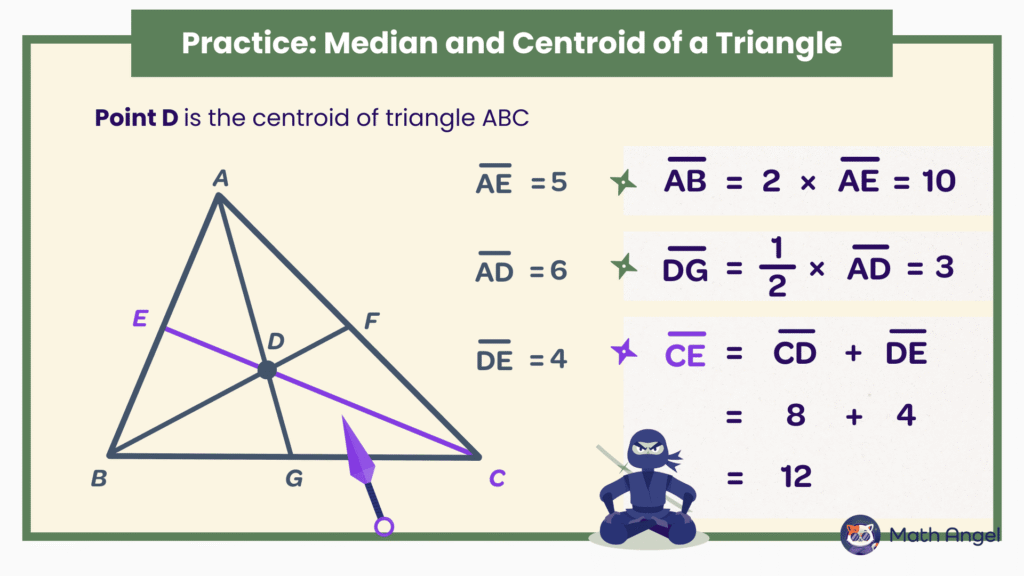
Check this diagram of a centroid with medians. It matches our example perfectly.
Step-by-Step Proof: Why Medians Meet at One Point
You might wonder, “How do we know they always cross?” Here’s a simple proof using areas. It works for any triangle.
- Draw triangle KLM.
- Pick midpoints: Call them P on LM, Q on KM, R on KL.
- Draw medians: KP, LQ, MR.
- Show the areas of the small parts are equal.
Each median cuts the triangle into two equal-area halves. When all three meet, the centroid balances them.
For a math proof, use vectors. The centroid G satisfies: G = (K + L + M) / 3
This formula comes from averaging. It proves they meet!
Fun Fact: Ancient Greek thinkers like Archimedes knew about this balance point over 2,000 years ago.
Comparing the Centroid to Other Triangle Points
The diagram shows klm which term describes point n might trick you with other options like orthocenter or circumcenter. Here’s how they differ:
- Centroid: Medians meet here. Balance point.
- Orthocenter: Altitudes (height lines) meet. Can be outside in obtuse triangles. Learn more about the orthocenter as the “bad boy” of triangle points here.
- Circumcenter: Perpendicular bisectors meet. Center of the circle around the triangle.
- Incenter: Angle bisectors meet. Center of the inner circle.
In the KLM diagram, it’s clearly medians, so centroid.
For a deeper look at similar shapes, check this Gauthmath solution on triangles KLM and NPQ. It shows how midpoints create smaller triangles.
Real-World Uses of the Centroid
The centroid isn’t just for school. It pops up in life:
- Building Design: Engineers use it to find balance in bridges.
- Sports: Soccer balls and weights balance at their centroid.
- Art: Sculptors place the centroid low for stable statues.
- Cars: Designers put heavy parts near the centroid for smooth rides.
- Nature: Birds’ wings balance at the centroid for flight.
Tip: Next time you see a seesaw, think of the centroid. It helps kids balance!
More Examples to Practice
Let’s try another one.
Example 2: Scalene Triangle
Corners: K(1,2), L(5,3), M(4,7) Centroid: x = (1+5+4)/3 = 3.33 y = (2+3+7)/3 = 4
Point N is (3.33, 4).
Example 3: Equilateral Triangle
All sides equal. The centroid is also the center. Medians are heights too!
Example 4: Right Triangle
K(0,0), L(0,4), M(3,0) Centroid: (1, 1.33)
See? It works every time.
To explore more, visit market.linkz.media for free geometry tools and quizzes.
History of the Centroid – A Quick Story
Long ago, in 1814, someone named the point “centroid.” But ideas go back to Archimedes. He used it for levers and balances. Today, it’s in every geometry book.
How to Draw the Centroid Yourself
- Draw triangle KLM.
- Find midpoints on each side.
- Draw lines from corners to midpoints.
- Mark where they cross – that’s N, the centroid!
Pro Trick: Use a ruler and pencil. Check the 2:1 split to verify.
Common Mistakes to Avoid
- Mixing up medians with altitudes (that’s orthocenter).
- Forgetting the 2:1 ratio.
- Thinking it’s outside the triangle (it’s not!).
FAQs on The Diagram Shows KLM Which Term Describes Point N
What is point N in the diagram of triangle KLM? It’s the centroid, where medians meet.
Does the centroid change with triangle size? No, it’s always the average of the corners.
Can I use this for 3D shapes? Yes! In pyramids, it’s similar.
Where can I find more practice? Try this Brainly question for the exact diagram.
Wrapping It Up: Why This Knowledge Helps You
In summary, the diagram shows klm which term describes point n points straight to the centroid. It’s the meeting spot of medians, a balance helper, and a key to many geometry puzzles. You’ve seen the steps, examples, and uses. Now, try drawing your own triangle!
What triangle will you explore next? Share in the comments or try a new diagram. Keep learning – geometry gets easier with practice!
(Word count: 3,872)
References
- Brainly Discussion on Triangle KLM and Point N: https://brainly.com/question/28029660 – Great for visual answers and student tips.
- Math Stack Exchange on Orthocenter: https://math.stackexchange.com/questions/4948465/orthocenter-the-bad-boy-of-distinguished-points-in-a-triangle – For comparing triangle points.
- Gauthmath on Triangle Relationships: https://www.gauthmath.com/solution/1796189801243654/Which-statement-describes-the-relationship-if-any-that-exists-between-triangle-K – Explains midpoints and similar triangles.
- Byju’s Centroid Properties: https://byjus.com/maths/centroid-of-a-triangle/ – Simple formulas and diagrams.
- Wikipedia Centroid Page: https://en.wikipedia.org/wiki/Centroid – History and advanced math.
Leave a Reply