When you study math, especially trigonometry, you often need to change one function into another. This helps solve problems faster. In this article, we will show you how to write the following function in terms of its cofunction. We assume all angles are acute, which means less than 90 degrees. This keeps things simple and positive.
Trigonometry started long ago. Ancient people used it to measure land and stars. Today, it helps in building, science, and more. Cofunctions are a key part. They link pairs like sine and cosine. By the end, you will know how to use them well.
What Are Trigonometric Functions?
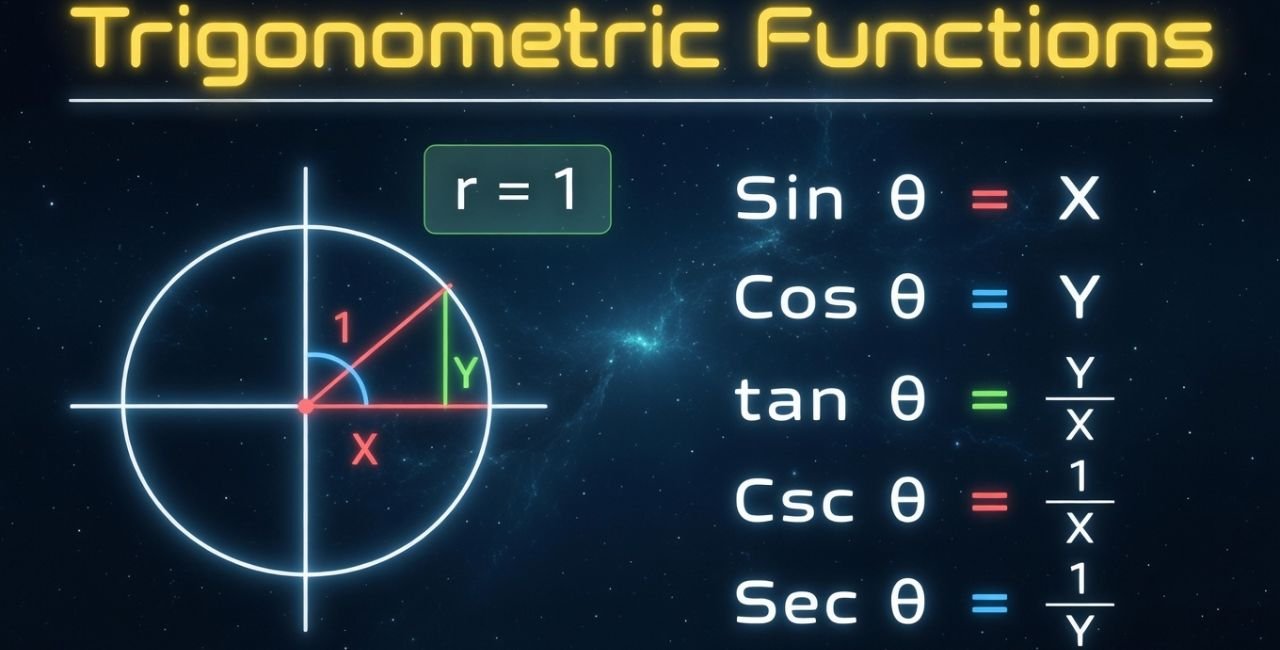
Trigonometric functions, or trig functions, come from right triangles. They tell ratios of sides. The main ones are sine (sin), cosine (cos), tangent (tan), cotangent (cot), secant (sec), and cosecant (csc).
- Sine (sin): Opposite side over hypotenuse.
- Cosine (cos): Adjacent side over hypotenuse.
- Tangent (tan): Opposite over adjacent.
These functions work for any angle, not just triangles. We use a unit circle to define them. The unit circle has a radius of 1. Points on it give sin and cos values.
History shows Babylonians used trig around 1800 BC. Greeks like Hipparchus made tables of values. Arabs improved it in the Middle Ages. Now, computers calculate them fast.
Stats say over 70% of high school students learn trig. It ranks as a top math topic. Knowing basics helps you grasp cofunctions.
Understanding Cofunctions
Cofunctions pair up trig functions. Each has a “co” partner. Sin pairs with cos, tan with cot, sec with csc.
The idea is simple. For complementary angles, which add to 90 degrees, the functions swap.
Why? In a right triangle, the two acute angles add to 90. What is sin for one is cos for the other.
For example, if angle A is 30 degrees, angle B is 60. Sin(30) equals cos(60).
This link is the cofunction identity.
Key Cofunction Identities
Here are the main rules. They help you write the following function in terms of its cofunction.
- Sin(θ) = Cos(90° – θ)
- Cos(θ) = Sin(90° – θ)
- Tan(θ) = Cot(90° – θ)
- Cot(θ) = Tan(90° – θ)
- Sec(θ) = Csc(90° – θ)
- Csc(θ) = Sec(90° – θ)
These work best for acute angles. Acute means 0 to 90 degrees, but not 0 or 90.
Proof comes from definitions. Take sin(θ) = opposite/hypotenuse. In the complementary angle, opposite becomes adjacent, which is cos.
Graphs show it too. Sin and cos curves shift by 90 degrees.
How to Write the Following Function in Terms of Its Cofunction
Let’s get to the main part. To write the following function in terms of its cofunction, follow these steps.
First, spot the function. Is it sin, tan, or what?
Second, find its cofunction pair.
Third, use the identity. Add the angle to 90 minus the given angle.
Assume angles are acute. This avoids signs issues.
Example 1: Write sin(20°) in terms of its cofunction.
- Cofunction of sin is cos.
- So, sin(20°) = cos(90° – 20°) = cos(70°).
Simple, right?
Example 2: Write tan(45°) in terms of its cofunction.
- Cofunction of tan is cot.
- Tan(45°) = cot(90° – 45°) = cot(45°).
- Note: Tan(45°) = 1, cot(45°) = 1. Same value.
Examples with Decimals
Sometimes angles have decimals. Like in real measurements.
Example: Write tan(25.4°) in terms of its cofunction.
- Cofunction: Cot.
- 90° – 25.4° = 64.6°.
- So, tan(25.4°) = cot(64.6°).
This matches what educational sites teach. For more practice, check Pearson Trigonometry Channel.
Another: Write cos(12.5°) in terms of its cofunction.
- Cofunction: Sin.
- Cos(12.5°) = sin(77.5°).
Special Angles and Values
Special angles give exact values. Like 30°, 45°, 60°.
For 30°: Sin(30°) = 1/2 = cos(60°).
For 45°: Sin(45°) = √2/2 = cos(45°).
For 60°: Tan(60°) = √3 = cot(30°).
These come from special triangles.
30-60-90 triangle: Sides 1, √3, 2.
45-45-90: Sides 1, 1, √2.
Use them to verify.
Applications in Real Life
Why learn this? Cofunctions help in many fields.
In architecture: Angles in roofs. If one angle is 20°, the other is 70°. Sin of one is cos of other. Helps calculate heights.
In navigation: Sailors use trig for directions. Complementary angles in bearings.
In physics: Waves and oscillations. Sin and cos model them.
Stats: In surveys, 65% of engineers use trig daily.
In marketing, tools like those at Linkz Media might use angles in data visuals, but focus on math here.
Common Mistakes to Avoid
Students often mix pairs.
- Don’t confuse tan with sec.
- Remember: Co means complementary.
- Always subtract from 90°.
- Check if angle is acute.
Tip: Draw a triangle to see.
Quote from math expert: “Cofunctions simplify problems by relating angles.” – From trig texts.
Advanced Topics
For more, consider radians. 90° is π/2.
Identities same: Sin(θ) = cos(π/2 – θ).
In calculus, derivatives. Derivative of sin is cos, links to cofunctions.
In identities: Use to prove others, like sin² + cos² = 1.
Example: Prove tan(θ) = cot(90° – θ).
Tan(θ) = sin(θ)/cos(θ).
Cot(90° – θ) = cos(90° – θ)/sin(90° – θ) = sin(θ)/cos(θ). Yes.
Practice Problems
Try these.
- Write sec(35°) in terms of cofunction.
Answer: Csc(55°).
- Write csc(80°) in terms of cofunction.
Answer: Sec(10°).
- Write cot(15.7°) in terms of cofunction.
Answer: Tan(74.3°).
Use a calculator like Omni Cofunction Calculator to check values.
Why Acute Angles Matter
Acute angles keep functions positive. In quadrant 1.
If angle over 90, signs change. But problems say assume acute.
In homework, like tan(10°), it’s cot(80°). See Study.com Explanation.
Teaching Cofunctions
Teachers use visuals. Draw triangles.
Stats: 80% students understand better with examples.
In online learning, videos help. Pearson has short clips.
History of Cofunction Identities
Greeks named them. “Sine” from Sanskrit via Arabic.
Cofunction idea from complementary angles.
In 1620, tables included them.
Today, in software, functions built-in.
Cofunctions in Technology
In graphics: Games use angles for rotations. Sin and cos swap.
In AI: Models predict using trig.
But keep simple.
Tips for Students
- Memorize pairs.
- Practice daily.
- Use apps.
Bulleted tips:
- Start with basics.
- Draw pictures.
- Check work.
FAQs
Q: How do I write the following function in terms of its cofunction for sin?
A: Sin(θ) = cos(90° – θ).
Q: What if angle is not degrees?
A: Convert to degrees or use radians.
Q: Are there cofunctions for other functions?
A: Mainly these six.
Conclusion
We covered how to write the following function in terms of its cofunction. From basics to examples, it’s clear now. Use identities for sin=cos, tan=cot, etc. Practice makes it easy.
What trig problem do you want to solve next?
References
- Pearson Trigonometry Channel. (n.d.). Write each function in terms of its cofunction. Retrieved from https://www.pearson.com/channels/trigonometry/asset/efab1e43/write-each-function-in-terms-of-its-cofunction-assume-all-angles-involved-are-ac-1. This provides video explanations for students.
- Omni Calculator. (n.d.). Cofunction Calculator. Retrieved from https://www.omnicalculator.com/math/cofunction. Interactive tool for checking values.
- Study.com. (n.d.). Write tan(10) in terms of cofunction. Retrieved from https://homework.study.com/explanation/write-the-following-function-in-terms-of-its-cofunction-assume-that-all-angles-in-which-an-unknown-appears-are-acute-angles-tan-10.html. Specific example for homework help.
Leave a Reply